
阿塔纳斯·乔治耶夫:新形势下中国与中东欧国家能源合作的新机遇
发布时间:2025-11-05
今年是中国国家主席习近平提出共建“一带一路”倡议12周年。中山大学区域开放与合作研究院于2025年10月12日在广州校区南校园举办《开放合作发展报告(2025):全球价值链重构与“一带一路”开放合作》成果发布暨开放合作高端学术研讨会。高端学术研讨会以“全球价值链重构新态势与深化‘一带一路’开放合作”为主题。中山大学党委副书记王帆出席开幕式并致辞,中国社会科学出版社社长季为民研究员致辞。研讨会由中山大学区域开放与合作研究院和中山大学经济高质量发展研究中心共同主办。《开放合作发展报告(2025)》作者之一,保加利亚索非亚大学经济及商业管理学院院长阿塔纳斯·乔治耶夫教授应邀就“新形势下中国与中东欧国家能源合作的新机遇”发表主题演讲。观点如下:
New Opportunities for Energy Cooperation Between China and CEE Countries
新形势下中国与中东欧国家能源合作的新机遇
Dear professor Mao, dear colleagues, it is a great pleasure for me to greet you from Sofia, Bulgaria in this early morning, 12th October. I'm grateful for the opportunity to present to you recorded message due to the time difference between our countries and my report will be about the opportunities for cooperation between China and Central and Eastern European (CEE) countries in the context of the current global challenges and the European policies in place.
亲爱的毛艳华教授,亲爱的同事们,我很高兴从保加利亚历史最悠久的索非亚大学向你们致以亲切的问候。我的报告主题是:在当前全球面临多重挑战以及欧洲政策深入推进的背景下,中国与中东欧国家之间的能源合作呈现新的机遇。
So we are currently in a stage where the European Union is trying to reinvent itself. Maybe you all know about the Draghi Report, a report written about a year ago by the former Italian politician Mario Draghi, who presented a number of challenges and some solutions after the review of the European economy and its challenges. Unfortunately, some of the challenges have been exacerbated during these periods, but also there are some opportunities to be explored in Bulgaria. The countries of Central and Eastern Europe are well positioned to be part of the solution and not just part of the problem. The European Green Deal, which is a very complex set of policy in place, is still valid. The European Union is trying to decarbonize its economy through the decarbonization of crucial sectors like the energy or transportation, agriculture, buildings, etc. And this makes the challenge even tougher because some of the good conditions that have been present, the formulation of this policy more than five years ago are currently not there, we don't have so much cheap energy now. The investment environment is not so good anymore. But this also means that there are opportunities for investment coming from other parts of the world and not explicitly from the traditional trade partners.
欧盟正处于自我重塑的关键阶段。一年前,意大利前总理马里奥·德拉吉的《德拉吉报告》,全面评估了欧洲经济现状及其面临挑战,并提出一系列应对方案。尽管过去一年中部分挑战进一步加剧,但包括保加利亚在内的中东欧国家依然蕴含巨大潜力,有望成为解决方案的重要部分。欧洲绿色协议旨在推动能源、交通、农业和建筑等关键行业实现脱碳。然而,与五年前政策制定之初相比,当下环境已发生显著变化,低成本替代能源的可获得性下降,投资环境也不如从前有利。然而,这一变化同时为来自非传统贸易伙伴的投资打开了空间。
Also, we have still the same challenge of the large share of fossil fuels in the economy. As you can see here, all the countries in the European Union are still heavily reliant on coal, oil and gas. There are some successful stories, but they are not enough to overthrow the fossil fuels on their position in the European energy balance. So one of the main opportunities here is new investment and innovation related to carbon is energy solutions, which could be in the more traditional domains like solar and wind, but also in other innovative places. And again, there are some very good examples, usually related to hydrogen, geothermal of other traditional renewables, whereas the new types of renewables are still not very fast to penetrate. There have been reports related to this issue by some industrial associations like Wind Europe calling for more coordinated action for the support of renewables like wind, solar batteries that could help the integration into the energy system. And the countries in Central and Eastern Europe are actually quite fast. Bulgaria is one specific example of integrating these new types of electricity sources. This is extremely valuable when these countries are well connected to their neighbors. Again, like the Bulgarian case, still the fossil dependence of the energy sector in the economy, it also means that a lot of energy is imported.
欧盟成员国仍普遍高度依赖煤炭、石油和天然气等化石燃料。尽管有一些能源转型的成功案例,但尚不足以改变化石能源在能源结构的主导地位。因此,推动与碳减排相关的投资与创新成为当前的重要方向。这些投资既涵盖太阳能、风能等相对成熟的领域,也延伸至氢能、地热能及其他新兴技术。然而,新型可再生能源的渗透速度仍相对缓慢。欧洲风能协会等组织发布报告,呼吁加强政策协调,以支持风能、太阳能等可再生能源的发展。值得关注的是,中东欧国家在能源转型方面进展显著,例如保加利亚在新型能源整合方面取得重要突破。
European Union is devoted to decreasing the level of fossil fuels combined with better management of energy security and the security of energy supply and at the same time fostering competition for new smaller producers of energy to get into the market. Again, as for the Central and Eastern European countries, they have some advantages because some of the main investments, like in Bulgaria and Romania, have been exactly in the energy sector in this subsection, the specific policy in place regarding EU is targeted towards diminishing dependence on fossil fuels.
欧盟正通过多项举措降低对化石燃料的依赖,强化能源安全与供应保障机制,促进市场竞争,吸引中小型能源供应商。上述目标均得到专项投资基金支持。中东欧国家例如保加利亚和罗马尼亚也成为吸引大量投资关注的重要区域。
Part of the energy transition of technology is the industrial development of green technologies. There have been some innovations that have made their way toward industry production, but combined with some new regulations related to sustainability in some countries. So still, Europe is dependent on imported technologies. We can see here that, of course, China is a leader in this field. One of the possible ways is to cooperate between China and Central and Eastern European countries, by fostering investment related to production of decarbonization technologies inside the European Union, which could be very valuable.
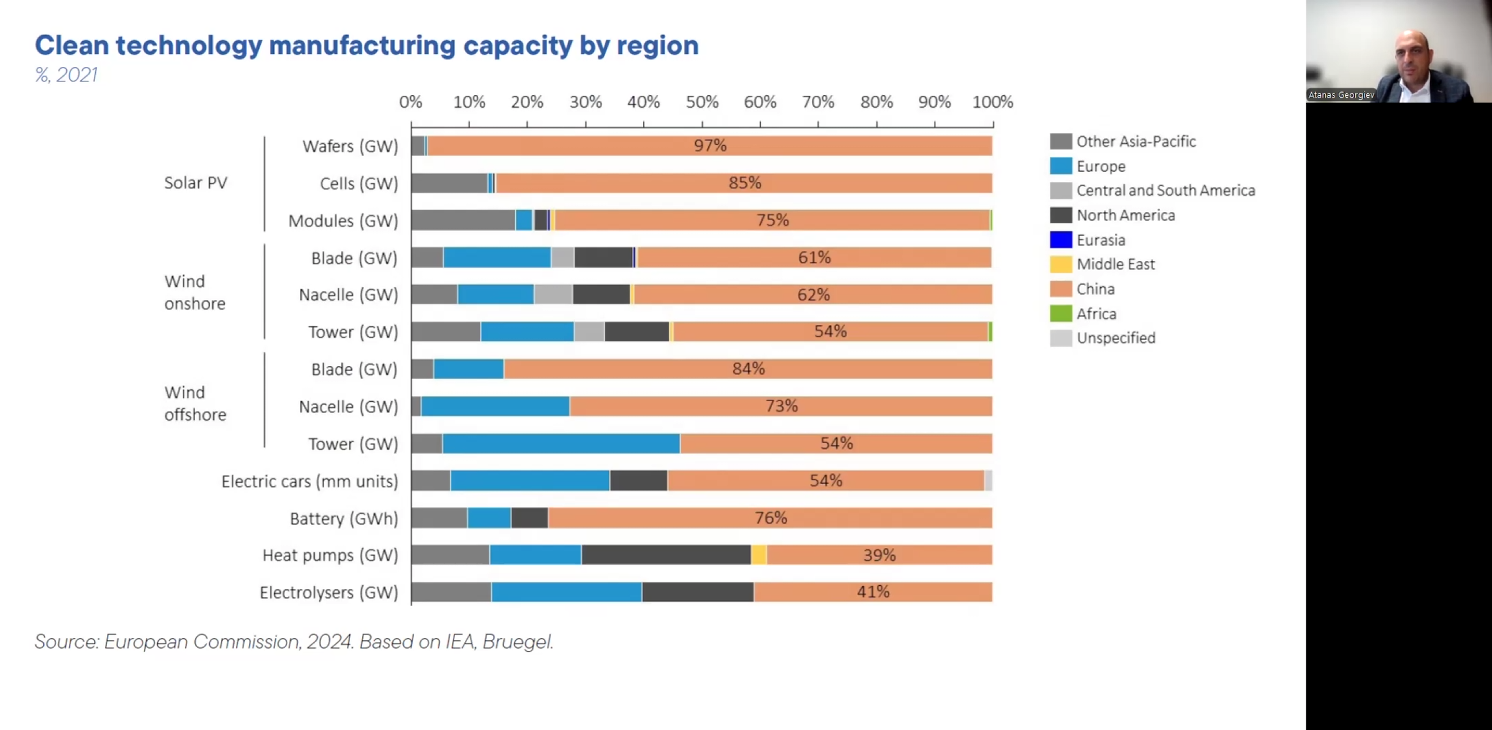
另一重要维度是绿色技术产业化发展。目前该领域发展态势呈现不均衡特征。尽管部分技术已实现产业化应用,但在一些国家相关行业仍投资不足。欧盟在绿色技术领域仍高度依赖进口。中国作为绿色技术的重要供给方,可通过与中东欧及其他欧洲国家合作,推动脱碳技术在欧盟本土的生产与投资布局。
And there are a number of innovations that are waiting for their way to get to the consumer. This is an example by the International Renewable Energy Agency Innovation Report, about 100 innovative technologies. We see here that the potential for growth is quite huge. And some of these technologies could be produced in the European Union with cooperation between Chinese and European companies so that there is no dependence on explicit exports of these technologies. There is also the challenge of the carbon market. The carbon border adjustment mechanism is still not fully implemented, but it is one more reason to consider local production of joint venture companies between China and European companies inside the European Union, because more and more imported goods will be subject to check, and we should not forget that there is a special support system on European level but also on national level, the so called the Net-Zero Industry Act, which lists 19 technologies that support decarbonization and are eligible for earmarked European and national funding for development. Also, there is a special regime related to the critical raw materials, the critical Raw Materials Act, this putting special goal for the European Union to look into a number of strategic materials. And there are specific targets for the European countries to implement in the next years until 2030, so that a larger part of the extraction, processing, and recycling of such critical raw materials is done inside the European Union.
据国际可再生能源机构的报告显示,约有100项创新技术处于商业化前阶段,显示出巨大潜力。部分技术有望通过中欧企业合作在欧盟内部实现本地化生产。此外,碳市场机制亦带来新的挑战与机遇。欧盟碳边境调节机制虽未全面实施,但已促使企业更倾向于通过中欧合资在欧盟境内生产,以应对日益严格的碳监管要求。欧盟及各成员国层面已建立专门的政策支持体系。例如,《净零工业法案》明确19项重点支持的脱碳技术,配套专项发展资金;《关键原材料法案》旨在推动关键原材料的开采、加工和回收过程有更大比例在欧盟内部完成。
Thanks a lot!
(以上内容由现场记录整理,未经报告人审定)
编辑:陈倩怡
审核发布:毛艳华